Menu +
Back to Use Cases

Retail / Distribution

Building the data foundation behind automated inventory replenishment.

In high-SKU retail, better replenishment does not begin with the optimization algorithm. It begins with trusted, synchronized, decision-ready data.

Inventory intelligence is a data synchronization problem before it is an optimization problem.

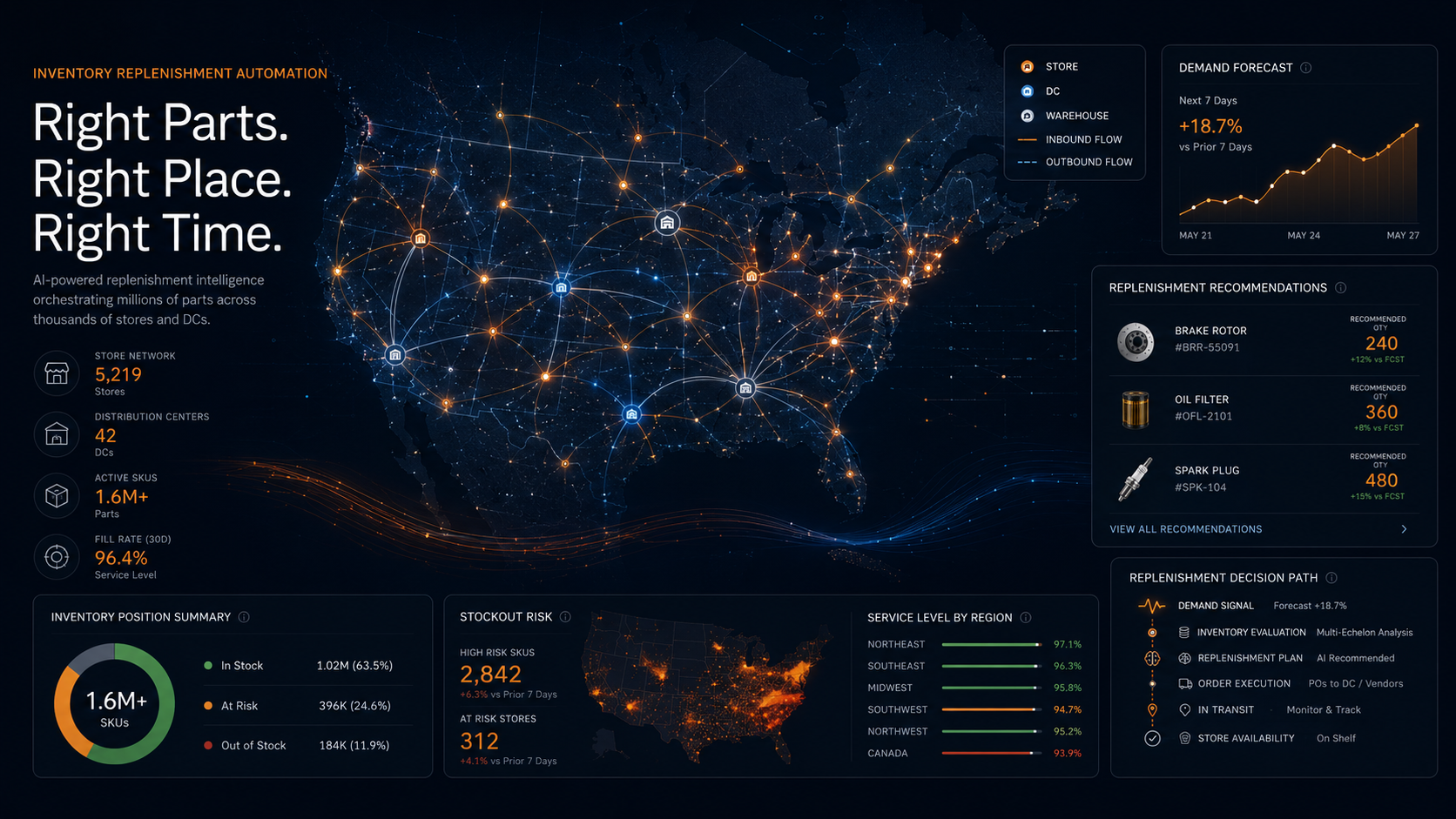
Inventory replenishment command center with SKU, store, demand, and replenishment signals

Executive situation

A leading automotive aftermarket parts provider with more than 5,000 stores across North America wanted to improve product availability. The business challenge was shaped by demand across 200,000+ parts, low average sales velocity per part, high inventory carrying costs, lost sales when parts were unavailable within two hours, and duplicate systems created by a recent merger.

The company initiated an automated stock replenishment program involving demand forecasting, proportional inventory management, and automatic order generation.
The challenge beneath the challenge

The visible business problem was replenishment. The deeper challenge was data standardization across a fragmented retail ecosystem.

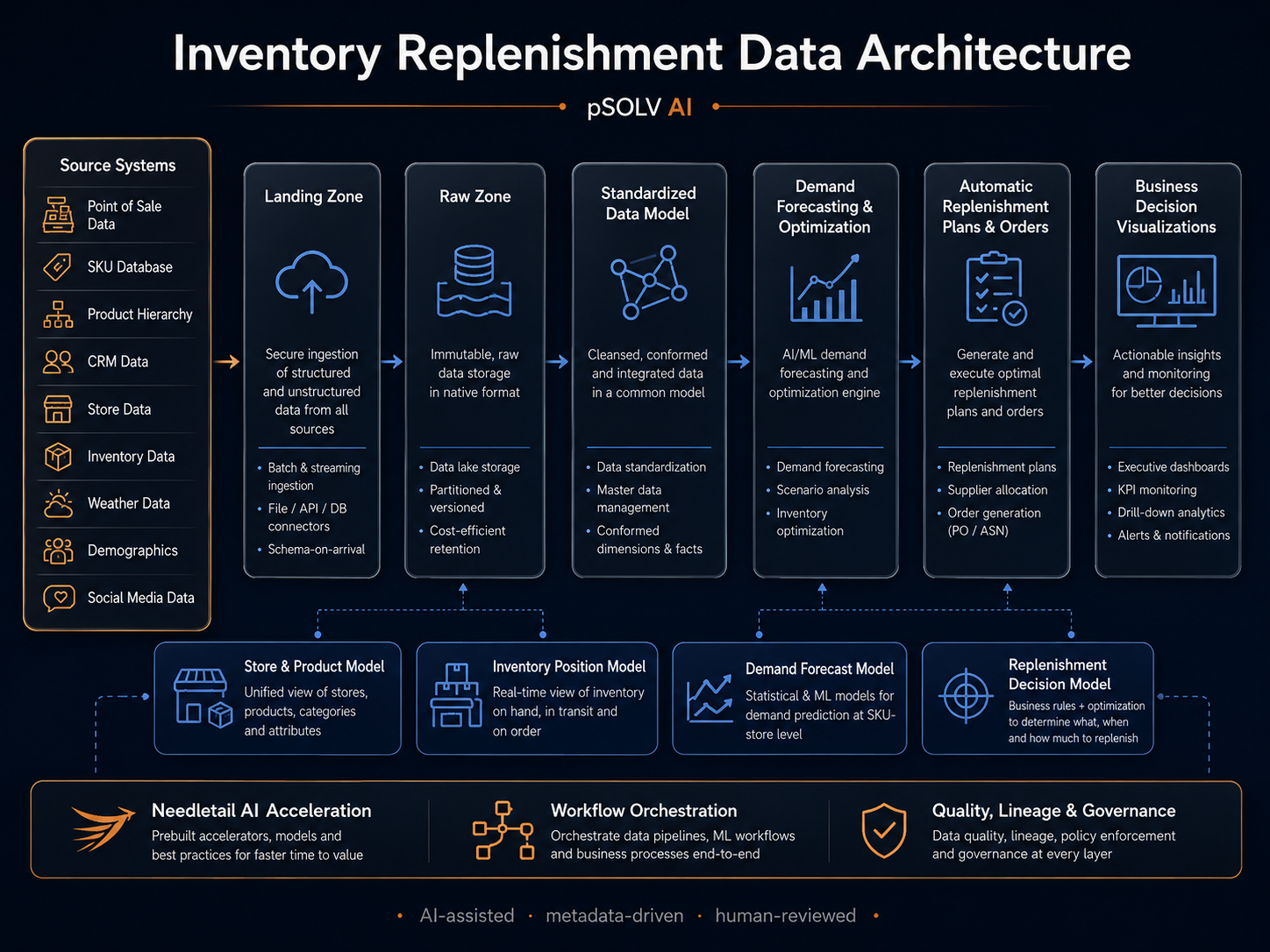
The case required ingestion, cleansing, and transformation of POS data, SKU databases, product hierarchy, CRM data, store data, inventory data, weather data, demographics, and social media data. The system had to scale horizontally to handle volume, variety, and velocity across these sources.

Architecture view

Inventory replenishment data architecture connecting product, inventory, sales, and demand signals

Why conventional delivery struggles

Automated replenishment programs often fail when the data pipeline is treated as plumbing rather than a decision system.

Generic delivery can struggle because:

1

product, store, and inventory entities are not harmonized

2

duplicate systems produce inconsistent signals

3

demand data is not aligned to replenishment decisions

4

quality issues appear late, after optimization logic is already built

5

business users cannot trace recommendations back to trusted inputs

pSOLV point of view

Inventory replenishment is not only an optimization problem. It is a data-product problem.

The right foundation connects store, SKU, product hierarchy, inventory, demand, weather, demographic, and external signals into a trusted replenishment data product that can support forecasting, assortment, ordering, and business decisioning.

How Needletail AI accelerates the workflow

Needletail AI can accelerate replenishment workflows by helping teams:

  1. 1

    discover and profile source systems

  2. 2

    map product, store, SKU, inventory, and demand entities

  3. 3

    identify duplicate-system harmonization needs

  4. 4

    define data-quality rules for replenishment readiness

  5. 5

    scaffold lineage from source systems to decision outputs

  6. 6

    generate first-pass pipeline and data-product designs

  7. 7

    support human-reviewed sprint planning

Workflow anatomy

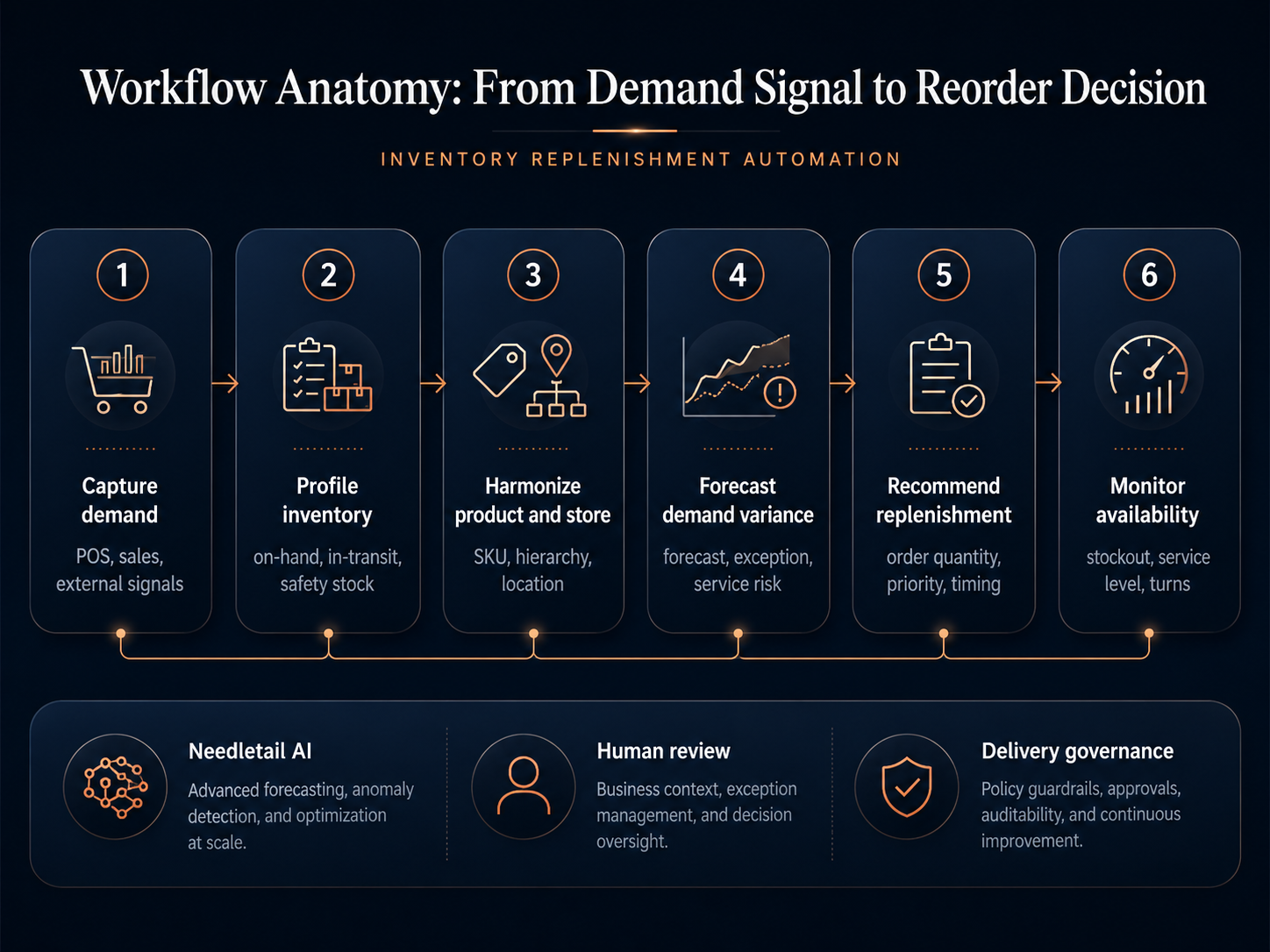
Sources, foundation, controls, and outputs in one delivery view.

Inventory replenishment decision flow from demand signal to reorder recommendation

sources

POS, SKU database, product hierarchy, CRM, store data, inventory, weather, demographics, social signals

foundation

source harmonization, standardized replenishment model, scalable processing platform

controls

quality checks, entity matching, data consistency, orchestration

outputs

demand prediction, assortment optimization, replenishment recommendations, visualizations for business decision-making

Business outcomes

The original case reported rapid implementation of an end-to-end solution, significant performance improvement from 20 hours for one market to 25 minutes for all markets, and end-to-end supply-chain visibility for power users.

faster replenishment analytics

improved supply-chain visibility

stronger foundation for automated ordering

improved performance of optimization workflows

reduced manual effort in preparing demand and inventory signals

Next step

Start with one replenishment decision that depends on better data.

Start with one workflow