Menu +
Back to Use Cases

Retail / Supply Chain

Turning global supply chain complexity into store-level decision intelligence.

A global retail supply chain does not fail because forecasting is missing. It fails when the data beneath forecasting is fragmented, delayed, inconsistent, or hard to govern.

Retail supply-chain intelligence starts with trusted store-level data foundations.

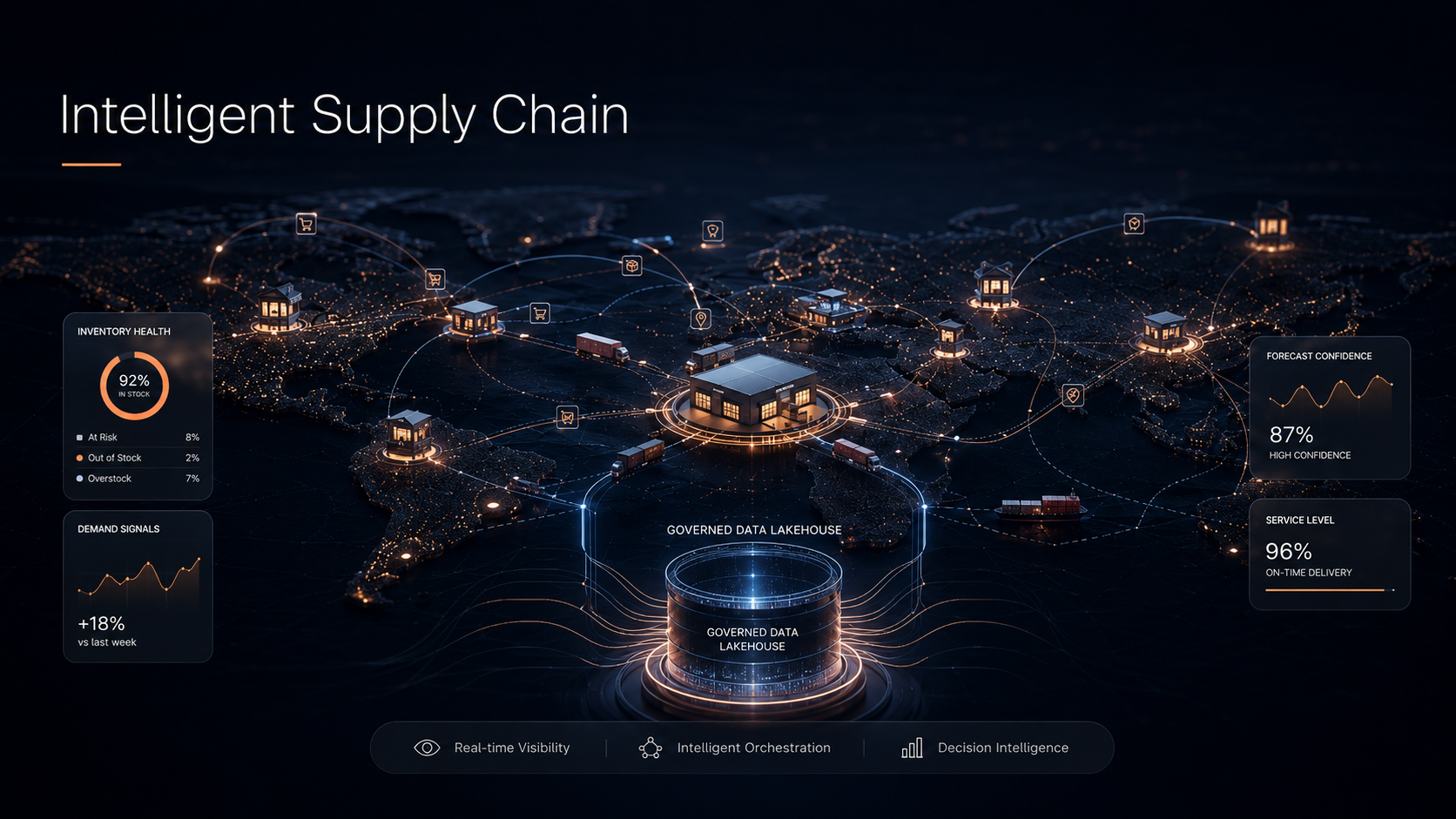
Global supply-chain data network connecting stores, inventory, delivery, and planning signals

Executive situation

A global beverage company with more than 29,000 stores was pursuing an augmented intelligence initiative to transform supply-chain planning. The goal was to optimize product delivery across stores and balance supply and demand at store-level granularity using insights from millions of point-of-sale transactions.

This is the kind of enterprise problem where analytics ambition is visible, but the data foundation challenge is hidden. To make store-level planning work, data from operational systems must be ingested, standardized, validated, and made available for downstream decisioning.
The challenge beneath the challenge

The visible challenge was supply-chain planning. The deeper challenge was multi-source data readiness.

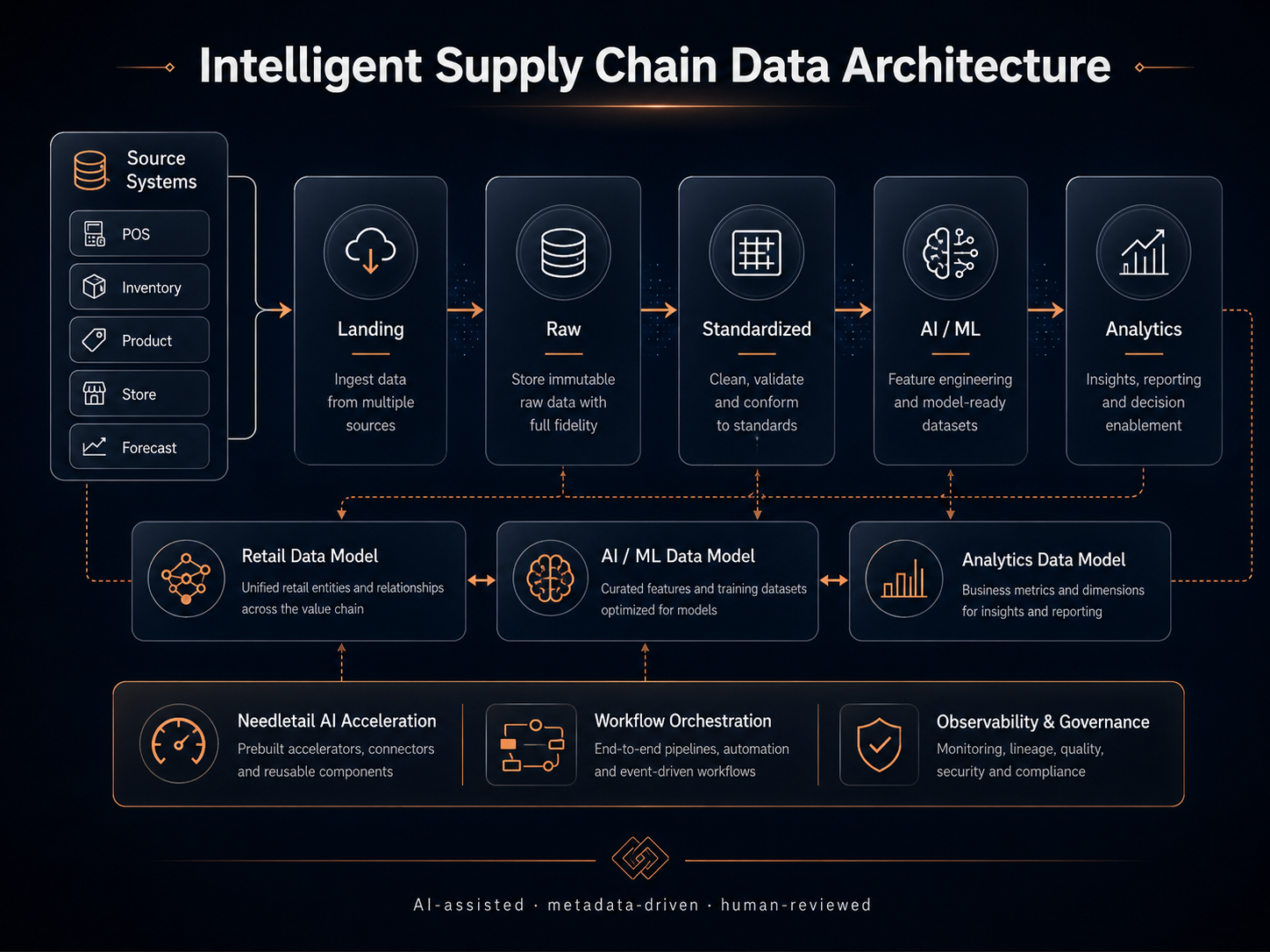
The case required data from ERP systems, POS transactions, supply-chain networks, delivery schedules, and inventory systems. The data also included large volumes of semi-structured JSON, and the volume, variety, and velocity required a greenfield big-data processing platform capable of supporting cloud-scale forecasting and planning.

The enterprise issue was not simply build a pipeline. It was to create a reliable operating foundation where transaction, order, master, and inventory data could become trusted inputs for planning decisions.

Architecture view

Supply-chain data architecture showing operational sources flowing into Needletail AI and planning outputs

Why conventional delivery struggles

Traditional delivery often begins with pipeline implementation before the full workflow is understood. That creates three risks:

In supply-chain environments, those gaps matter. A delayed POS signal, inconsistent inventory quantity, or ungoverned product hierarchy can distort downstream planning and replenishment decisions.

1

Source complexity is underestimated.

2

Quality and merge-contract rules are added too late.

3

Business users see technical progress before they see planning confidence.

pSOLV point of view

Supply-chain intelligence is not a dashboard problem first. It is a governed data-flow problem.

The right starting point is to identify the operational data domains that drive the planning workflow, standardize them into a reliable model, enforce quality controls early, and create traceable outputs that business teams can trust.

How Needletail AI accelerates the workflow

Needletail AI can accelerate this class of workflow by helping teams move faster through:

  1. 1

    source discovery across ERP, POS, delivery, supply-chain, and inventory systems

  2. 2

    schema and metadata profiling

  3. 3

    entity inference across store, product, transaction, inventory, and delivery domains

  4. 4

    pipeline design and orchestration planning

  5. 5

    quality-rule drafting for completeness, freshness, and merge integrity

  6. 6

    lineage scaffolding from source systems to planning outputs

  7. 7

    human-reviewed delivery artifacts for sprint or pilot execution

The goal is not autonomous production delivery. The goal is faster movement from source complexity to a reviewed, governed, implementation-ready plan.

Workflow anatomy

Sources, foundation, controls, and outputs in one delivery view.

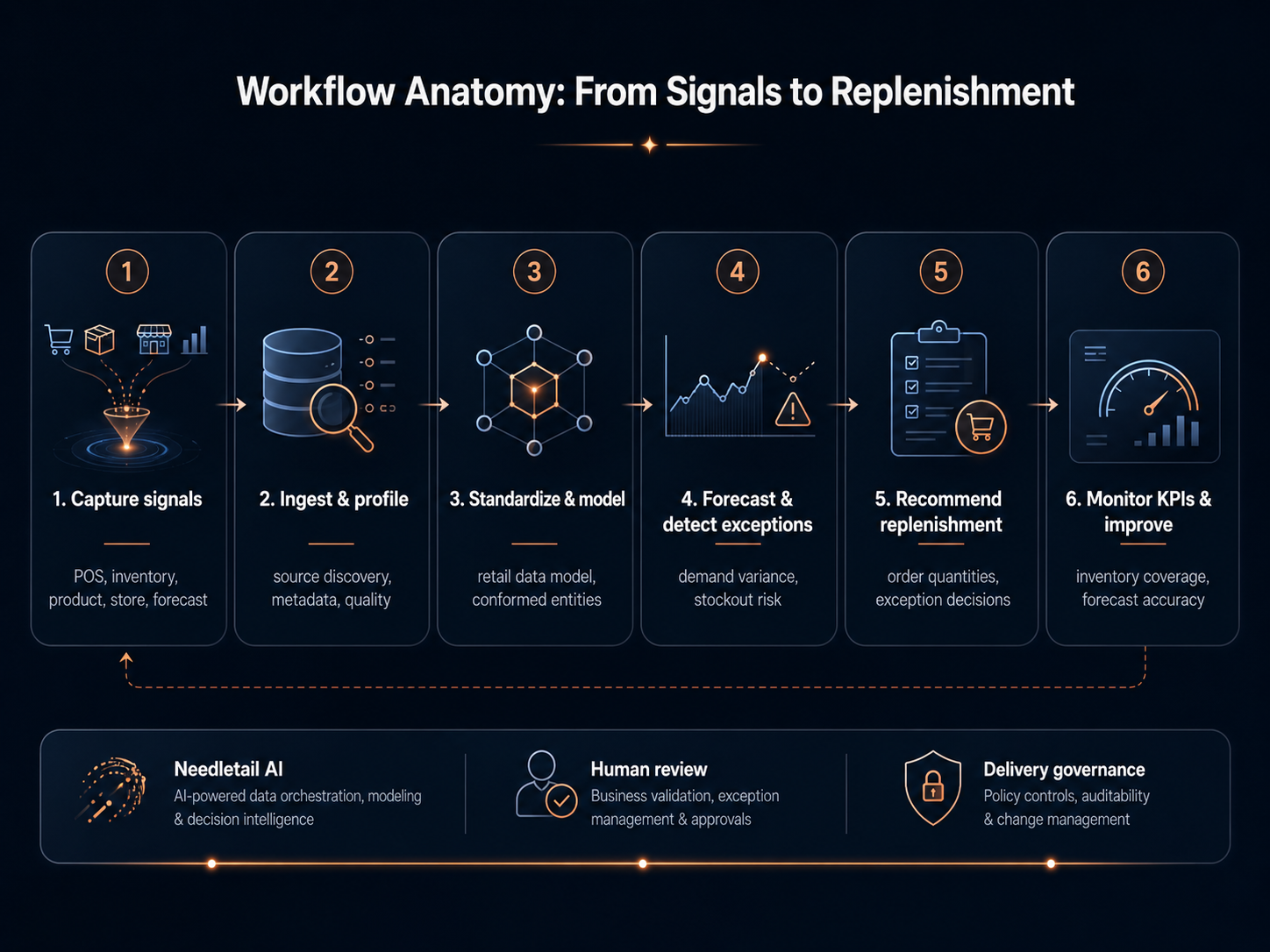
Supply-chain workflow anatomy from raw sources to forecasting inputs and store-level action signals

sources

ERP, POS, supply-chain network, delivery schedules, inventory systems, semi-structured JSON

foundation

ingestion, cleansing, transformation, standardized operating model

controls

merge-contract enforcement, data-quality checks, orchestration, cloud-resource optimization

outputs

planning-ready data, forecast inputs, store-level supply-demand signals, operational decision products

Business outcomes

The original case reported scalable, automated, timely processing of large data volumes, built-in merge-contract enforcement for integrity and quality, optimized cloud resource usage, and a solution architecture aligned to best practices.

faster preparation of planning-ready data

stronger confidence in supply-chain planning inputs

improved ability to support store-level supply-demand decisions

reusable pipeline patterns for future planning workflows

better governance over high-volume operational data

Next step

Start with one planning workflow that depends on trusted data.

Start with one workflow